In order of appearance on blog: Fernando - ROME 1960: The Olympics as a Catalyst for Urban Change Olivia - United Colors of Tiburtino : Neorealism and the Search for a New Vernacular Yao - Stazione Termini in Esquilino: Towards a Locus Solus of urban Dystopia Agnes - The Roman Palazzina Khaleel - Development of the EUR: A Representation of Fascism Heera - The Colosseum through times: Functions and Symbols Esther - Circus Maximus: A Contemporary Public Space Melissa - The Sporting Complex: Stadio Olimpico and its’ Fascist Influence Matt - Villa Doria-Pamphili: Evolution of an Emerald from Private to Public Peter - Tuscolano: Neorealism and the Peripheral Development of Postwar Rome Shichun - The Ex-slaughterhouse in Testaccio: Survival through Reuse Anjuli - The Garbatella: The "Garden City" and its Community Maria - Prati: The Other Rome William - Corviale: A Controversial Housing Implementation
Mega-events such as Universal Expositions, World Fairs and the modern Olympic Games are short-term occasions that, since their inceptions, have consistently had a major impact on the urban system.They posses a unique ability to restructure civic plans and priorities, to form discussions about usage after the event, to promote urban redevelopment, and are instruments of ideologies that enthusiastically promote economic growth.[i]As a recent article in the International Journal of the History of Sport stated, “There is a constant intimacy between Olympic development and the evolution of host cities.”This assertion is greatly substantiated when discussing the Summer Olympics of 1960, when the Italian capital, Rome, secured the rights to host the Games of the XVII Olympiad.The Roman Games established a turning point in the Olympic history, as they became an archetype of the mega-event as a catalyst for significant urban change.From this spectacle in 1960 onwards, the Games began to have several extensive consequences on the local built environment, as the Olympic venues and infrastructure became key elements of the comprehensive urbanistic intervention.[ii]In addition, this physical capacity of the Olympics has generated several other effects, including a new image of the host cities and an enhanced sports culture.
To secure the hosting rights of the 17th Olympiad, Rome had to compete in an unprecedented race against fifteen other candidates, including four European and seven American cities.In June of 1955, after four failed attempts, the International Olympic Committee finally declared Rome as the next Olympic headquarters.Although the Second World War had ended a decade before, these Games were to be the first ones staged after the period of post-war austerity, thus amassing a potential to create great change.Indeed, the Olympic plan that was carried out over the next half-decade in Rome truly presented the Games as a forceful trigger for major urban development and improvement that went well beyond the construction of sports facilities.[iii]
With five years to prepare for the 1960 spectacle, the city of Rome sought to develop three focal zones for Olympic activities, and to design a comprehensive system of transportation infrastructure throughout the city.The main sporting facilities were clustered in three separate sites, two in the northern outskirts of the city, and one in the southern periphery, thus stretching the built area in two directions.The organizers capitalized on these areas where relevant facilities were already available: the Foro Mussolini sports complex constructed during the Fascist Era; the Flaminio area which had for several decades retained a particular character devoted mainly to sports events and leisure; and the E.U.R., a district south of the city center that was initially designed as an extraordinary setting for the 1942 Esposizione Universale Romana (E.U.R.), which never occurred because of WWII.
Announced in 1927, the original Foro Mussolini became the boldest new project announced by the Fascist regime.Completed in 1938, the sports complex reflected the regime’s efforts to undertake projects beyond those dealing with ancient sites in the historic center.Instead, the Foro would offer Rome a new “city” devoted to sports, physical fitness, and youth—a city of physical education in the tradition of the ancient gymnasium but in a modern form consistent with the regime’s program.[iv]Thus, its use as an Olympic center was an appropriate decision.Renamed the Foro Italico, the complex housed the revamped 80,000-seat Stadio Olimpico (formerly Stadio di Cipressi), the upgraded Stadio dei Marmi, the new Stadio del Nuoto, and the completed area in front of the immense Palazzo della Farnesina.
Across the river, in the Flaminio district, several more projects were realized.The old Stadio Nazionale was replaced with the new Stadio Flaminio, while the Palazzetto dello Sport, an indoor arena designed by Pier Luigi Nervi, was constructed to host boxing matches.The foremost project in Flaminio, however, was the construction of the Olympic Village.This residential complex boasted 1,800 apartments that would house all 5,348 participating athletes and their coaches.[v]After the two-week spectacle, the apartments were subsequently handed over to the state, and became the most successful intervention of public housing in the city.
More so than the vast Olympic Village at Flaminio, the most ambitious project assumed during this time was the revamping of the E.U.R. site.Although the district had originally been designed as the fairgrounds for the 1942 Rome Universal Exposition, the Olympic preparations nearly two decades later stimulated a major redevelopment.Some of the most important sporting facilities of the city were constructed here during this period, including the Palazzo dello Sport (today the nation’s largest sport arena), the Piscina delle Rose (swimming pool), the Laghetto dell’EUR (artificial lake) at the central park, the Tre Fontane sports training area, and the recently demolished Velodromo for track cycling competitions.In total, nearly three billion Liras were spent in the redevelopment of EUR.[vi]
Aside from the actual facilities constructed or improved at the Foro Italico, Flaminio and EUR, a major aspect of the Olympic plan was the network of roads that would connect these sites, located at opposite ends of the city periphery.Thus, the decision to use the Foro and EUR as Olympic clusters not only brought back to life images of the Fascist regime, but required the longest and most costly highways to link them.Two were built, running north-south at either edge of the city, and stimulating real-estate development all along their routes.Thus, Rome gained from infrastructural improvements undertaken with the Games in mind, especially the new roads and bridges built to connect the Olympic venues.
The main clusters were connected by a new thoroughfare called the Via Olimpica (Olympic Way), built just in time for the Games in 1960.During its construction, the Via Olympic was very controversial for being exceedingly expensive and laborious, and was nicknamed “the trail of gold,” in large part because it seemed that the extensive pathway was built to raise the value of nearby lands.Connected the Olympic Village and the Foro Italico in the north with EUR in the south, the Via used stretches of existing roads throughout its course, before crossing the Flaminio bridge (1951) and into the Olympic Village.The Corso di Francia, built between 1958 and 1960, was an elevated viaduct that bypassed the newly constructed Olympic Village and across the Tiber River, connecting Via Cassia and Via Flaminia with the center.In all, $2.8 million were spent on the network of internal roads, $6.4 million on the external road network, and another $3.5 million on the connection from north to south of the city.This was in addition to the $21 million spent to construct Fiumicino Airport, which was inaugurated just five days before Opening Day of the Games in 1960.As the total investment on the Olympic Games was approximately $45 million (64 billion Liras), 75 percent of the total expenses were set aside specifically for transportation-related infrastructural investments.Incidentally, this road network was the largest project of the Olympics, occupying 75 percent of the total land used for the event (12).These lavish developments even led to requests for the annulment of the next Summer Games because of the increasing scale and complexity of the Olympic urban commitment (13).
Aside from the Olympics-related projects discussed, the city also developed a new water supply system, new hotels, a new jetport, improved public transport, street lighting and illumination of monuments, and numerous decorative improvements to the city’s urban landscape.Thus, in many ways, Rome used the occasion in 1960 to reinforce its permanent facilities and urban infrastructure.The 1,800 apartments that housed the athletes in the Olympic Village were used after the Games as low-income housing.The Flaminio area as a whole was revitalized, after years of being covered with barracks.Major traffic routes amplified for the Games now accommodate the ever-increasing use of private automobile activity throughout the metropolis, especially the Olympic Way and the Corso Francia.Many of the sports facilities built or improved for the Olympics continue to be in use today, including the Olympic Stadium at the Foro Italico, the Palazzo dello Sport in EUR, and the Palazzetto dello Sport in Flaminio.[vii]Investing more than a third of all the funding for the Olympics on the airport at Fiumicino, Rome finally acquired its major international connection to the world.
In summary, the Rome Olympics of 1960 was a defining moment in the history of the modern Olympic movement, as it became the first major Olympiad to trigger a wide range of lasting urban improvements.Unlike the earlier productions of the Games, the Olympic sport spectacles since 1960 on have retained a vigorous tendency to stimulate and accelerate major developments such as new road systems, public transport initiatives, air terminals, urban renewal programs, tourist and cultural facilities, and parks and beautification projects designed to enhance the city’s landscape and environment.Indeed, the expenses involved in staging an Olympic celebration are now so excessive that host cities can often only justify the expenditure when it is seen as leading to a major program of regeneration and improvement.Thus, it can be said that the modern Olympics have developed from a comparatively small-scale beginning, and emerged as a remarkable catalyst of urban change and a considerable instrument for urban policy.[viii]
There are certain implications that surface as the modern Olympics continue to increase in scale and infrastructural requirements.Originally set out to be a celebration of human physical ability and cooperation through sport, it seems that the immensity of the spectacle has overshadowed its original philosophy.Most athletes are now professionals rather than amateurs (think of the 1992 NBA “Dream Team”); the Games have become dependent on commercial sponsorships and television rights (both of which first came into the picture during the Olympics in Rome); and the infrastructural commitments and scale of investment are so imposing that no Olympic Games have yet to be staged in South America or Africa.It will be especially interesting to observe what course the Olympic movement takes in future stages, as the most recent production of Beijing 2008 has certainly proven. The decision to allow the Chinese capital the hosting rights—despite concerns about mass displacement of entire communities, environmental hazards, human rights abuses, television coverage restrictions, a 40-billion-dollar production cost, etc.—was an indication of the International Olympic Committee’s interest in host cities and countries that are willing to extend themselves to their limit to stage a successful Games.Perhaps the Rome Games nearly half a century ago spoiled the Olympic Committee, opening its eyes to a new and incomparable spread of possibilities and influence that could be achieved through the Olympic Games, and justified in the name of fair play.
[i] Hiller, Harry H. “Mega-events, Urban Boosterism and Growth Strategies: An Analysis of the Objectives and Legitimations of the Cape Town 2004 Olympic Bid”. International Journal of Urban and Regional Research. 24.2 (2004): 450-1.
[ii]Liao, Hanwen, and Adrian Pitts. “A brief historical review of Olympic urbanization”. International Journal of the History of Sport. 23.7 (2006): 1232-3.
[iii] Gherarducci, Mario. I Giochi sono fatti: La storia, i personaggi e i resultati delle Olimipiadi dal 1896 ai nostri giorni. Milano: Zelig, (1996).
[iv] Painter, Borden W. Jr.Mussolini’s Rome: Rebuilding the Eternal City. New York: Palgrave Macmillan, (2005).Pg. 14-15.
[vi] Gold, John R., and Margaret Gold. “Olympic Cities: Regeneration, City Rebranding and Changing Urban Agendas”. The Authors Journal Compilation. (2008): Pg 305.
[vii] Kirk, Terry. The Architecture of Modern Italy.New Jersey: Princeton Architectural Press, (2005).
[viii] Kitchen, T. “Cities and World Events". Process, Town & Country Planning. 65.11: 1996. Pg 314-316
Neorealist Architecture and the Search for a New Vernacular
"They had strange forms, with pointed roofs, little terraces, dormers, round and oval windows: people began to call the place Alice in Wonderland, Magic Village, or Jerusalem..”
-Pasolini (Casciato 36)
[INA-Casa Tiburtino housing project, 1949-54]
Just beyond the fringe of the city, Tiburtino stands ambiguously in its multi-colored, playful facades, celebrated by its inhabitant yet dismissed by its very designers. Constructed between 1949 and 1954, it is the earliest one of INA-CASA housing projects, and a paradigm of neorealist architecture. By the second-half of the twentieth century, neorealism gained a new momentum as conceptions of modernism shifted in parallel with the new reality of the Italian state and its democratic ideals. Diverging from rationalist and fascist attitudes, the new ideology was in search of a vernacular language that was rich in tradition and sensitive to the needs of the ordinary, common individual facing the repercussions of the war. Such was the case with the architects of Tiburtino, whose goal was to provide a remedy for housing shortage through the design of “architecture on the human scale” (Casciato 45). Tiburtino was thus a comprehensive project in scope, attempting to find an equilibrium between social values and functional yet organic design, and ultimately testing architecture’s limits in realizing that ideological pursuit.
[INA-Casa Tiburtino housing project, 1949-54]
History: Towards a New Democracy By the end of the war, housing became one of the chief concerns in Italy’s reconstruction, as six percent of housing or “over two million rooms” were damaged (Kirk 156). Efforts began by establishing governmental and financial structure from 1944 to 1948, paving the way to the planning and executing of large housing projects by the end of the decade. Tackling the problem of unemployment and lack of housing was a considerable task, and these social goals had to work in sync with the overall design in a speedy yet effective manner. It was certainly an ambitious project that had ethical and social underpinnings, and to challenge the architects even further, they were to institute a new aesthetic and artistic expression stripped away from Fascism and adhere to the principles of a new democracy. While the former style was dictated by a rational, monumental, and academic tradition, detached from the “architecture of daily life” indifferent to the individuals, the new design was to critically consider the psychological, social, and material needs of the individual and the society at the same time (Casciato 32).
[Palazzo della Civilta del Lavoro, example of Italian Fascist architecture]
This idea was first elaborated in Bruno Zevi’s 1945 Towards and Organic Architecture, in which he proposed an architecture that was not bound by authority, but one that was functional from technical, social, and psychological point of view. It is by no surprise that in the Manuale dell’ Architetto (The Architect’s Handbook), a mass produced handbook created in 1946 which set up criteria for the fields in architecture and planning design, proposed solutions stemming from the idea of an organic architecture. The manual drew its references from the elements of German functionalist as well as craft techniques, which would later be realized in Tiburtino. Organizations like APAO (Associazione per l’Architettura Organica) and various literatures, including the journal Metron, also propounded upon the idea of a more authentic and “realistic” architecture giving emphasis on the people who occupy it.
These conceptions were soon to be realized in 1949 through the Fanfani Law, which spawned the growth of large-scale housing projects nationwide. The national insurance institute INA (Istituto Nazionale per le Assicurazione) oversaw and executed the housing legislation INA-Casa until it expired in 1963. The INA-Casa Tiburtino complex was one of the earliest of its prototypes and a significant one, embodying a wide scope from the architectural component to its very details. The overall plan was designed by Mario Ridolfi, while Ludovico Quaorni focused on the aspects of urban planning. The complex was situated in an L-shaped area of 88,000m2 to accommodate about 4000 inhabitants. Along with its 770 apartment units, there were shops, social centers, as well as sports facilities and green spaces.
[site plan of Tiburtino housing complex]
In Context: Back to the Roots
What was most compelling in the vision for Tiburtino was thus the humanistic approach. It was an approach away from rigidity and towards a “continuity” that Ernesto N. Rogers in Casabella stressed in 1952. It was a comprehensive ideology responding to the postwar reality, which left the nation fragmented and in desperate search for a cohesive national identity, not just in the realm of politics, but the Italian culture as a whole. By means of referencing back to a common, shared history, tradition, and culture, it aimed to make a connection back to the ordinary individuals occupying that reality.
[Vernacular Roman builings as precedents for Tiburtino]
Through this nostalgic lens neorealism entailed a strong emotive participation. This is epitomized in Tibertino, where the principal design goal was to give “careful consideration of habits, local traditions, climate, latitude, and altitude, local construction materials, crafts, workmen, and building systems…bearing in mind the spiritual and material needs of a man, of a real man and not an abstract being” (Casciato 33). This intimacy and sensitivity towards tradition was achieved through a plan reminiscent of a medieval Roman village, fostering a more intimate setting and a sense of natural growth of a local community.
In place of austere and abstract geometries of modernism, a more fluid continuity was introduced to provide mediation between public and private spaces (Casciato 29). Along with distorted winding roadways, housing blocks were organized into clusters, opening up public spaces, allowing multiple viewpoints and stimulate both architectural and social interaction. This composite experience that the Tiburtino project attempted to render “was exploiting to the utmost emotions that a man walking along the street might experience” (Casciato 43).
Building: Finding the Dialect
Consequently, social obligations, psychological values, and architectural design had to all work in tandem to generate a quick yet comprehensive and functional solution. The general strategy focused on bringing in a local dimension, from the use of local workers, material and technologies to the very layout of the complex. Tiburtino project thus attempted to go back to the humble roots, mimicking “folk flavor” of traditional villages (Casciato 34). Yet it also had to consider the necessity and urgency of the postwar economic situation, accommodate high density and minimize building costs.
[Different building typologies in Tiburtino]
The 770 flats in Tiburtino were arranged in three building typologies, consisting of row houses, apartment blocks, and free-standing apartment towers, and ranging in height from three to eight floors. In addition to alternating heights and elevations with staggering rhythms that conform to the undulations of the site, plans rotate in such a way as to open up spaces with varying vistas. The composition gets more interesting in further detail. Row houses form triangular linkages, while loggias retain irregular forms, balconies begin protruding, and inclined roofs decorate the top. The institutional housing that would have been otherwise monotonous and devoid of character is now articulated and modulated through fragmentations and ruptures.
[staggering rhythm shown in elevation]
The architects were also concerned with traditional techniques and materials for detailing and construction. The exterior of row houses are covered with plasters, and underneath are layers of tufa stones with courses in brick. Plastered surfaces also cover apartment towers, which have frame construction of reinforced concrete. These surfaces are then painted with “Roman earth tones,” which are derived from local iron ore deposits. If the choice of materials is a straightforward borrowing from the rural peasant tradition, the design of minor details such as window shutters and railings of balconies and stairs take the Roman dialect one step further by giving them a modern touch. In effect, Tiburtino had an air of spontaneity and idiosyncrasy as it drew its inspiration from multiple sources and synthesizing different materials and forms: the housing models of Scandinavian and German-speaking countries and combining them with local tradition. Neorealist language in this way was not an entirely new one, but rather a rediscovery and re-activating of an existing vernacular. It was an amalgamation of sorts, heterogeneous in character.
[Colors of facades reminiscent of Roman earth tones]
Experience: A Cinematic Approach
The polychromatic character of Tiburtino share many commonalities with neorealist cinema. It was from the neorealist cinema from which the architects picked up the sensibility to rediscover and celebrate the “arcane Italy – the Italy of the common folk” and attempted to actualize it into architecture (Casciato 26). In both cases, a new sense of democratic identity was portrayed through its respective mediums.
[Bicycle Thieves, 1948 by De Sica]
In neorealist films, the democratic ideal was represented by dividing narratives into fragmented episodes, which contrasts with the unitary character of the fascism. Their goal was to depict “truth” and reality of these ordinary individuals whose lives were marked by the struggles they faced in search for a new life. The use of vernacular language and dialects, amateur rather than professional actors, and on-site film locations made it all the more realistic. In neorealist films, this culminated in a plot that involved actual, believable problems and characters (Bondanella 34). For example, in VittorioDe Sica’s 1948 film Bicycle Thieves(see film clip), an unemployed man finds a job, loses a precious bicycle, and wanders throughout Rome to find the thief without success (Landy 136).
[Bicycle Thieves, 1948 by De Sica; trailer]
In the same vein, neorealist architecture was in search for a new vernacular. Again, moving away from a hierarchical scheme, they brought together disparate elements and arranging those fragments in random fashion that resembled the spontaneous character of village, whereas neorealist films used fragmentation to represent spontaneous character of the lives of individuals. They were hoping to create a space “where each building had its own distinct physiognomy and everyone can find their home, feeling their own personality reflected in it” (Terranova 5).
Conclusion: Alice in Wonderland?
Aspirations of the new democratic state found its way into architecture in Postwar Italy, and neorealist architects put considerable effort to embody those ideals into the project, as seen in the INA-Casa Tiburtino quarter. Yet the project received criticism based on its nostalgic vision, and the effort to imitate a village-like neighborhood was dismissed for its artificiality. Designers of the project themselves repudiated it the pursuit for the picturesque, and critics labeled it as being exotic, baroque, and fantasy-like. The problem seemed to lie in the notion that the variety and spontaneity it tried to achieve was imposed upon the project in a deceiving and illusionistic way, making it appear as though the complex had been laden with history and built over time.
[Corviale vs. Tiburtino]
Regardless of the reception, from the perspective of an ordinary individual, Tiburtino is admirable because it gave respect to local culture and color such that current inhabitants are “enormously proud of their housing complex and maintain it beautifully” to this day (Ghirardo 2). Was not this the very premise of the project, to make connection back to the people? While housings such as Corviale have fallen into despair because its residents find it dehumanizing, it is still embraced by architects for its monumental and idealized architecture. Such a paradoxical contrast now raises the question of what really constitutes success in social housing.
Bondanella, Peter E. Italian Cinema: From Neorealism to the Present. Ungar film library. New York: F. Ungar Pub. Co, 1983. Casciato, Maristella. “Neorealism in Italian Architecture.” Anxious Modernisms: Experimentation in Postwar Architectural Culture. Ed. Sarah Williams Goldhagen and Réjean Legault. Montréal: Canadian Centre for Architecture, 2000. 25-53.
Kirk, Terry. Visions of Utopia, 1900 - Present. New York: Princeton Architectural, 2005. Landy, Marcia. Italian Film. National film traditions. Cambridge: Cambridge University Press, 2000.
Scrivano, Paolo. "Ludovico Quaroni, Mario Ridolfi: barrio INA-Casa Tiburtino, Roma = INA-Casa Tiburtino neighborhood, Rome." 2G: Revista Internacional De Arquitectura = International Architecture Review. 15 (2000): 28-35.
Giorgio de Chirico and Surrealist MythologyLocus Solus: a singular place, which works as the relationship of architecture to the constitution of the city and the relationship between the context and monument. -Aldo Rossi, Architecture of the City
History and Background:
The Esquilino hill, one of the Seven Hills of Rome, was traditionally a residential area of the rich and privileged. Its distance from the congested city center and availability of relatively cheap land, as well as the cool windy weather attracts the affluent city population to built villas and palazzos. The presence of leisure facilities such as the Bath of Diocletian further identifies the area as a high quality living quarter with tertiary service activities.
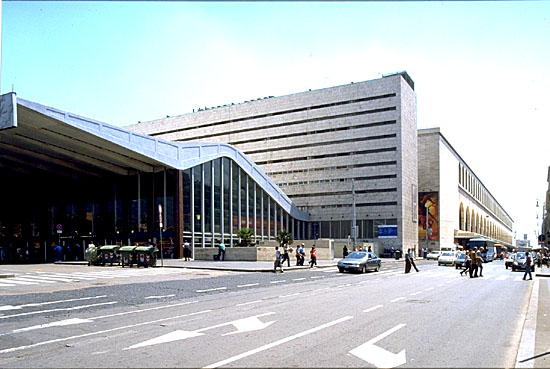
In 1863, Pope Pius IX opened the first termini station on the site of villa Montalto-Peretti , the station was constructed in 1868 and completed in 1874, based on the design by Salvatore Bianchiby. In 1937, in preparation for the planed 1942 world fair in Rome (which was never held), a new station was conceived to replace the old with a modernistic design by Angiolo mazzoni. Following the collapse of the Fascist Government in 1942, construction was interrupted and the current station in use was completed after a competition in1947 by two teams of architects: Leo Calini and Eugenio Montuori; Massimo Castellazzi, Vasco Fadigati, Achille Pintonello and Annibale Vitellozzi
The insertion of this piece of monumental infrastructure has stimulated much turbulence and change in the Esquilino neighborhood. Being Italy’s largest multi-ethnic district today, its transformation or so called degradation by Romans started long before the arrival of the immigrants. Its traditional affluent residents deserted it because of the chaos brought by the mobile population through the train station. The following lack of maintenance of the existing facilities further reduced the quality of the urban space, catalyzing its later occupation by the poor immigrant communities.
Lesson of Esquilino “Degradation”:
- The imposing modernity
Giorgio de Chirico and Surrealist Mythology
Modernity flourished after the industrial revolution and rise of the machine age. Modern architecture favors styles that simplify forms and eliminate ornament. Form follows function. These shifts in aesthetics and paradigm result in the production of an urban landscape with imposing monuments of machines.
The above image of the Termini imposing itself over the off-scale neighborhood has a curious resemblance to the photomontages of the “continuous monument” of Superstudio, In this project, the architects expressed concerns over the possible future when modern technology and culture renders the world uniform with a single continuous environment. Every point in the built world would be identical and neutral, without a distinct identity. The modern obsession with speed and efficiency has created the new orthodox of converting the historic city center into glorified railway intersection. The monotony and length of this modern machine of efficient transportation isolates itself from the continuous and richly composed Roman cityscape, hence generating a locus around it also detached from the urban landscape which follows its own modern development.
- The Paradox of futurism and tradition
In Piranesi’s etching “caceri d’invenzione” depicting an imaginary prison interior, he conveys an important idea: irrational and rational are no longer mutually exclusive. The problem of resolving equilibrium of opposites is fundamental to the concept of architecture.
In the AnalogousCity, through fragmentation, repetition and collage of types in his architecture and drawings of the city, Rossi expresses the same ‘equilibrium of opposites’ that Piranesi’s drawings proposed.
At Termini station, the continuous strip windows and dynamic structural lines expressing the Futurist idea of speed and streamlining, juxtaposed with the ancient Servian wall in front of the building façade, conveys a similar idea. The radical future adjacent to the ancient past, this collision is an apt manifestation of time and change in architecture. The dramatic contrast between the modernistic, even futuristic train station and the historic urban fabric creates a tension which disjoins the Termini affiliated area with the rest of the city, making it an isolated locus.
-The ambiguity of identity
Giorgio de Chirico and Surrealist Mythology
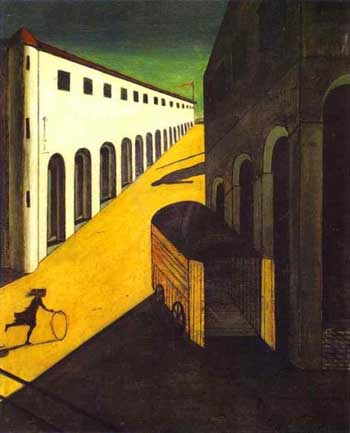
The Greek-Italian surrealist painter Giorgio de Chirico was famous for his metaphysical depictions of Italian cities. These imagery often included long porticos and colonnades, solitary monuments and figures, dramatically cast shadows and contrasting classical architecture with a new model of monumentality of the industrial age. They convey a suspended temporality, a blaze outlook prevalent in modern cities with nostalgia for the past in memory.
The two-kilometer long side structure of the design by Angiolo Mazzoni remains part of the current-day station. The parallel between this modern side façade clad in stone and glass and a roman aqueduct raise the question about the identity of this architecture. Is it modern or inherently archaic?
The ambiguity of the monumental architecture also blurs the identity of the neighborhood. Is it ancient or modern? Is it Roman or international? All people have a human desire to retain unique identity. A person’s past fulfills some inherent notion of a person’s individuality. When the monument of the locus does not provide a strong identity for the context, people define themselves by their past and memories. The Romans left for a traditional cityscape they identify with, while the immigrants settle for the multi- faceted modernity in the locus solus.
Within the Locus Solus:
Today, immigration has been the driving force behind the transformation of Esquilino. With the influx of immigrants from Asia, Africa, the Balkans and South America, of the 1,300 or so commercial premises operating in the district 800 are Chinese-owned, 300 are run by immigrants from other countries and some 200 are owned by Italians. Although the Esquilino is excluded from the city’s reconversion into an upper-class district, the socially segregated community within the locus solus develops their own rules and standards which stimulates a different urban development in the locus towards a globalised ethnic town which in the eyes of the Romans, an urban deterioration and dystopia.
It is also interesting to compare Rome with Manhattan and their reception of modern public infrastructure. Rome being a public city, the insertion of public infrastructure created a locus solus with logic different from the rest of the city. On the other hand, Manhattan being a private capitalist city, the insertion of public infrastructure like the Grand Central Station is well received by general public and fully integrated into the urban fabric. Maybe the tradition in Rome is so prevalent that any imprint of modernity, especially public projects with greater social impact, would easily create anomaly in the city landscape, becoming a locus solus of urban dystopia.
work cited:
Giorgio de Chirico and Surrealist Mythology
Architecture of the City: Aldo Rossi
Toward an Architecture: Le Corbusier
Rossi’s Poetics of the Fragment: The Physical (the City) and the Temporal (Memory)
This blog was created by students who participated in the Cornell in Rome Architectural Theory Course during the Spring 2009 Semester. The course was taught by Professor Gabriele Mastrigli. This blog highlights specific theoretical topics in the development of the city of Rome by explaining the rationale and functionality behind the projects mentioned here
itopia
A desire to construct the public realm permeates the visions and the concrete experiences of contemporary Italian architecture. This desire, deeply rooted in the past, from the roman basilicas to the piano sistino, has generated various attempts to design and build the idea of a truly public city: since the beginning of the XX century architecture has been the tool to shape not only the space of the contemporary city, but also the identities of the communities inhabiting it. As a mean to build the public city, architecture has been therefore a public activity in itself, closely connected to the political and cultural context, in which it has found unique conditions to make real some visions and theories about the contemporary city.
Rooted in the specificity of Italian situation, since modernity this idea of a public city has generated all over Italy several powerful - as much as controversial - experiments. Rome, in particular, due to its peculiar political and social situation, has been an exceptional ground for some of the most radical ones: not only new buildings but visions of a different society in the form of concrete and specific architectural and urban projects.